



Testing Efficacy and Impact of an AI Diabetic Retinopathy Screening Program in Primary Care Clinics
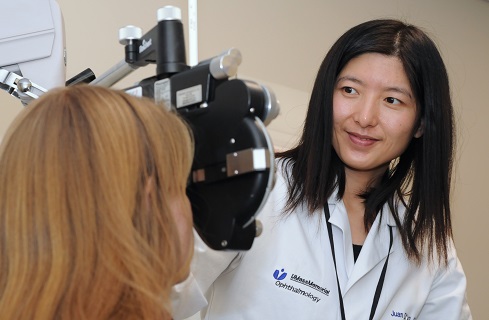
Optometrist Juan Ding, OD, PhD (above) and co-investigator James Ledwith, MD, assistant professor of Family Medicine and Community Health, were awarded the annual Herman G. Berkman Diabetes Clinical Innovation grant to implement an artificial intelligence (AI) diabetic retinopathy screening program in Family Medicine clinics to identify eye disease and improve comprehensive care for people living with diabetes.
“Despite vast improvements in screening and treatment of diabetic retinopathy in previous years, it remains a leading cause of vision loss in the United States,” said Dr. Ding, Director of Optometry Service, UMass Eye Center. “Many people face barriers to accessing quality eye care, including income, transportation, and health insurance. It’s important to improve methods of screening for diabetic retinopathy and make it widely available.”
Recent studies have identified AI-based algorithms as promising tools for screening and early identification of diabetic retinopathy, helping to identify those at risk. UMass Memorial Health partnered with digital health company AEYE Health to test the diagnostic accuracy of a handheld AI-assisted camera designed for primary care physicians to screen at-risk individuals for retinal changes indicative of diabetic retinopathy.
 The Berkman Fund will support efficient retinal imaging at primary care locations, and the program will analyze the impact of offering primary care screening and its sustainability. "Many of our practices only have completion rates of 30-40% for the annual retinopathy exam, reaching 60% in a few well-resourced sites," said Dr. Ledwith. "Many factors contribute to this; however, we expect performing the initial screening during routine primary care visits to improve screening rates and early disease detection greatly."
The current screening process requires primary care physicians to refer all their patients to an ophthalmologist for an annual eye exam. During this pilot program, people with diabetes who visit their primary care physician or nurse practitioner at UMass Memorial HealthAlliance Fitchburg Family Practice may be screened for retinopathy by a medical assistant or resident using an AI-assisted retinal camera. Retinal images from each eye are uploaded to a cloud-based service, which provides a report to the physician within a minute. If necessary, the patient can be referred to Dr. Ding or one of her colleagues at the UMass Memorial Eye Center for further evaluation.
“This technology may also be offered to patients within the UMass Memorial diabetes clinic to screen for eye disease so we can address it immediately,” said Dr. Ding.
Previous Berkman Award Recipients
Clinical Study on Diabetes Management for Pregnant Women to Improve Outcomes for Maternal and Infant Health
This study aimed to compare continuous glucose monitoring (CGM) with traditional fingerstick testing in pregnant women with type 2 diabetes to determine which method improves blood sugar control and pregnancy outcomes. Gianna Wilkie, MD, led the randomized trial at UMass Memorial Medical Center, evaluating glucose control, patient satisfaction, and perinatal outcomes, including rates of infants born larger than expected, with the goal of reducing future diabetes and obesity risk across generations.
Developing a Liver Disease Screening Process in the Adult Diabetes Clinic
Liver disease is strongly associated with type 2 diabetes and obesity. It remains underdiagnosed and undertreated, and many people living with T2D are unaware they have it. This project, led by Endocrinologist Madona Azar, MD, implemented a new process in the UMass Memorial diabetes clinic that uses a screening tool to analyze clinically available data to determine patients' risk of liver fibrosis.
The GOOD-ER Program
This randomized clinical trial provided continuous glucose monitors (CGM) to people with diabetes who were currently not using one and arrived at the Emergency Room with high or low blood sugar, or other diabetes related complications. The study, led by endocrinologist Dr. Mark O’Connor and emergency physician Dr. Laurel O'Connor, analyzed whether CGM effectively prevents people from returning to the ER for diabetes-related issues, compared with a control group that does not wear a device to monitor their blood sugar.
Improving Inpatient Blood Glucose Management
This project aimed to implement a carbohydrate-counting system for hospitalized inpatients with diabetes across the UMass Memorial Health system. Endocrinologist Dr. Leslie Domalik evaluated whether adopting a flexible meal dosing option based on carb counting would improve the outcomes of hospitalized patients with diabetes. By coordinating the timing of blood glucose testing, insulin dosing, and the administration of rapid-acting mealtime insulin, she wanted to ensure carbohydrate counts are listed for all food served to hospitalized patients and to better coordinate insulin delivery with meal delivery.
Identifying Diabetes Patients and Leveraging Underutilized Services to Improve Care’ (ID PLUS Care)
This project focused on a multidisciplinary, collaborative approach to improve care access, quality, and management for at-risk patients with diabetes. They monitored Electronic Health Record data to identify UMass Medicare Accountable Care Organization patients at risk for negative outcomes and proactively contacted patients to nudge them towards recommended services. It led to Dr. Daniel Amante receiving a three-year KL2 Mentored Career Development Training grant to develop a Diabetes Mellitus program using Behavioral economics to Optimize Outreach and Self-management support with Technology (DM-BOOST).